DATA MODELS

Data modelling is a fundamental process in database design and development, offering significant value by providing a structured and organized way to represent data. It helps in understanding, communicating, and managing data requirements effectively. The value of data modelling can be best understood by examining its different stages and associated models: Conceptual, Logical, Physical, and the Entity-Relationship Diagram (ERD).
The Value of Data Modelling
At its core, data modelling brings clarity and precision to data management. It helps organizations:
- Improve Data Quality: By defining data structures and relationships, inconsistencies and redundancies are reduced.
- Enhance Communication: Data models serve as a common language for stakeholders (business users, developers, analysts), bridging the gap between business needs and technical implementation.
- Increase Development Efficiency: A well-defined data model acts as a blueprint, guiding database development and reducing errors and rework.
- Facilitate System Maintenance and Evolution: Understanding the data structure makes it easier to modify, expand, and troubleshoot databases over time.
- Support Business Intelligence and Analytics: Properly structured data is essential for accurate reporting, analysis, and informed decision-making.
See separate pages for the stages of modelling
- Conceptual
- Logical
- Physical
- Entity Relationship Diagram (ERD)
In conclusion, data modelling, through its distinct stages and the use of ERDs, is invaluable for creating robust, efficient, and well-understood databases. It transforms abstract business requirements into concrete database designs, fostering better communication, reducing errors, and ultimately leading to more successful data-driven initiatives.
The modelling of a database is a progressive practice with models being built and extended from previous ones. Here is a brief outline of the sequence:
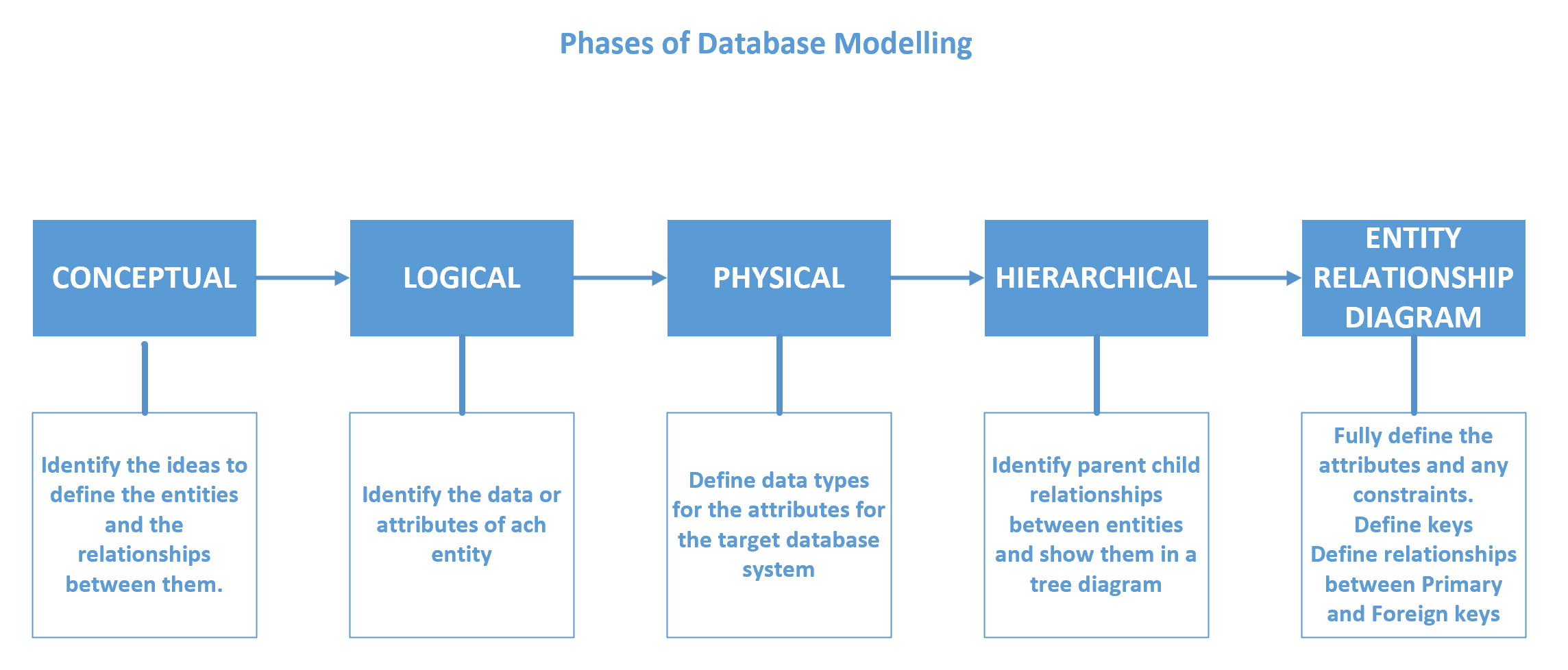
The value of Data Modelling as a formal process
The value of modelling a relational database