Entity Relationship Diagram (ERD)




An Entity-Relationship Diagram (ERD) is a graphical representation used to illustrate the entities within a system and the relationships between them. ERDs are typically used for conceptual and logical data models, providing a visual language for understanding data structures.
In many cases, the Physical Model would be sufficient to define the database for those responsible for making it.
An ERD (typically referring to a Logical ERD) provides business-centric value not present in a Physical Model by focusing on:
-
Business Concepts and Relationships: It defines entities (like "Customer" or "Order") and their relationships (e.g., "A Customer places an Order") in terms understandable to non-technical stakeholders. It emphasizes what data is important to the business and how those business concepts relate.
-
Platform Independence: A logical ERD is not tied to a specific database technology (e.g., SQL Server, Oracle). It represents the data structure purely based on business requirements, allowing for flexibility in choosing the implementation platform later.
-
Normalization and Data Integrity (Conceptual Level): While the physical model implements normalization, the logical ERD helps define the entities and attributes in a normalized way to minimize redundancy and ensure data consistency, driven by the business rules, before thinking about storage specifics.
In essence, the ERD captures the "what" of the data from a business perspective, while the Physical Model details the "how" of its technical implementation.
Thinking Point:
Does the modelling sequence described earlier always hav to hold? Are there contradictions?
Value:
- Visual Communication: ERDs offer a clear, intuitive visual representation of the data model, making it easy for all stakeholders to grasp complex data relationships.
- Clarity and Precision: They precisely define entities, attributes, and the cardinalities and optionalities of relationships.
- Design Validation: ERDs are excellent tools for reviewing and validating the data model with business users and technical teams, identifying potential issues early.
- Documentation: They serve as valuable documentation for the database design, aiding in future maintenance and understanding.
- Problem Identification: Complex relationships and potential data redundancy become more apparent in an ERD, allowing for early correction.
GRAPHIC
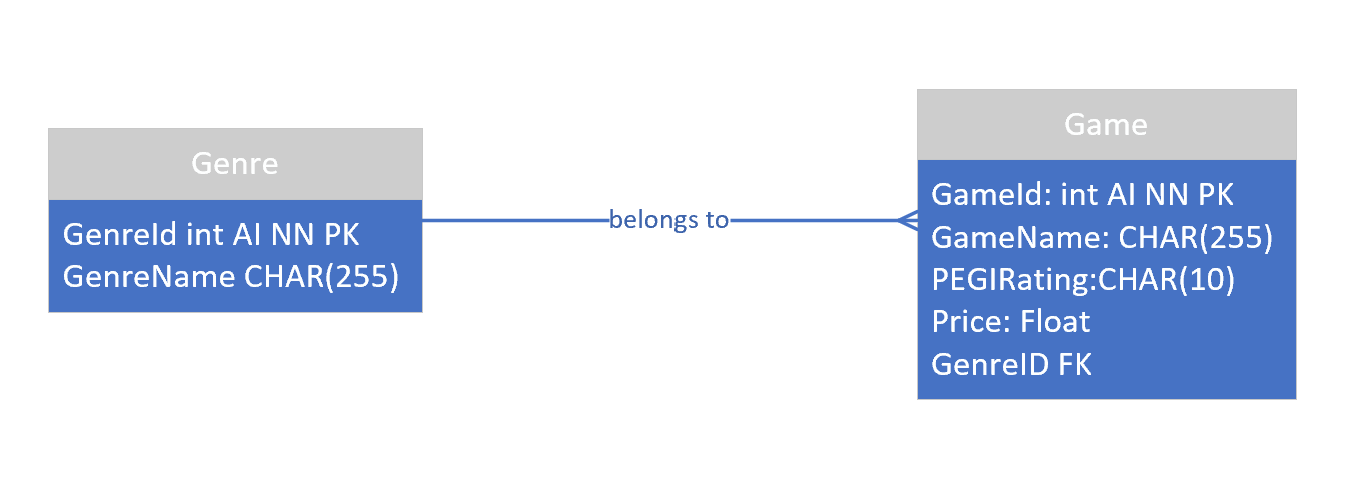
Info
This is a very small section of the full diagram. It illustrates the styles and syntax to be used.